
Ashtabula Projected Versus Actual Release
A projected date is a calculation or a parole-consideration marker. An actual release date records that custody ended through discharge, parole, judicial release, transfer, or another disposition. ODRC combines two concepts under the label Expected Release Date/Parole Eligibility Date. The field may hold a projected release date, called PRD, or a date pending parole consideration. POA means parole on or after and marks the earliest possible release to APA supervision, not a guaranteed exit.
A person held before trial generally lacks a computed sentence-release date. A bond order can authorize release, but staff must process it and check other holds. A dismissal can end one charge without ending custody on another case. For the Jefferson jail, the Sheriff's release or transfer record proves the physical event. For state prison, read the later ODRC status and Parole or Release Detail.
Find an Ashtabula Release Date
The correct path changes with the facility. Lake Erie Correctional Institution and other Ohio prisons use the ODRC Offender Search. A person held only at the Ashtabula County Jail may never appear there. City-jail and county-jail terms require the local court and custodian. NEOCAP completion belongs to the sentencing court, Adult Probation, and program trail.
- Identify the current or last facility. Do not treat disappearance from a roster as release because it may be a transfer.
- For ODRC custody, search by offender number when possible, preserving its letter prefix. Otherwise match name, date of birth, offense, docket, and County of Commitment.
- Open the detail and read status, sentence, jail-time credit, Expected Release Date/Parole Eligibility Date, next hearing month, and latest result together.
- For a county sentence, read the court's sentencing entry, commitment, and jail-credit award through the county court portal.
- Ask Sheriff's Records at 440-576-3545 for the actual release or transfer event when the Ashtabula County Jail held the person.
County of Commitment is a sentencing field. It does not state current residence, and ODRC warns that only the first county may be searched when several counties committed a person. Residential County and ZIP apply to APA or violator searches and may reflect an older recorded address.
The person detail also can show admission and institution data, sentence and offense information, docket numbers, jail-time credit, a hearing month, and the latest Board result. Read those fields as a set. A date for one sentence may not explain another consecutive term. A change of institution is a prison transfer, not release. For Lake Erie Correctional Institution, the statewide ODRC record remains the controlling search even though the prison is in Conneaut.
Ohio Earned Credit Is Not 85%
Ohio does not supply a safe rule that every prisoner serves exactly 85 percent. The shorthand partly reflects the aggregate 15 percent cap for specified ordinary credits in ORC 2967.194. For confinement on or after April 4, 2024, an eligible person may provisionally earn one or five days per completed month for productive participation and up to five more days for completing a second activity. Certain qualifying program completions can yield 90 days or ten percent of the stated term, whichever is less.
The statute has substantial exclusions. Mandatory or nonreducible terms and specified serious offenses or sentence types do not fit the ordinary calculation. Death, aggravated murder or murder and related forms, life without parole, certain Chapter 2971 terms, and qualifying sexually oriented offenses are among the listed boundaries. Earlier confinement can fall under ORC 2967.193's transition rule, while OAC 5120-2-06 supplies administrative mechanics.
Credits are only some inputs. Jail-time credit, concurrent or consecutive terms, mandatory parts, sentence amendments, judicial release, transitional control, and parole rules can change the result. For qualifying first- and second-degree non-life indefinite sentences after March 22, 2019, ORC 2967.271 creates a presumptive minimum and maximum framework. ODRC can rebut the presumption on statutory grounds and hold the person no later than the maximum. That is another reason a percentage calculator can mislead.
Why Ashtabula Release Dates Change
A displayed date can move as the official sentence record changes or the responsible body makes a new decision. OAC 5120:1-1-10 expressly says a Board-set PRD creates no entitlement and may be maintained, accelerated, or rescinded. A hearing result must be read by its label. A recommendation pending a judge, continued hearing, denial, or transitional-control review does not equal completed release.
| Factor | Possible effect | Record to check |
|---|---|---|
| Earned credit | May provisionally reduce an eligible term within statutory limits | ODRC sentence and credit record |
| Discipline or statutory exclusion | Can prevent or alter available credit | ODRC calculation, not a public percentage guess |
| Jail-time credit | Credits qualifying prior confinement | Sentencing entry and ODRC detail |
| Consecutive or mandatory term | Changes the combined calculation | Journal entries and sentence detail |
| Parole Board action | May continue review, deny release, or set/change a PRD | Latest hearing type and result |
| Detainer or transfer | May end one custody while another continues | Release/transfer record and receiving agency |
Confirm Ashtabula Actual Release
For a state prisoner, wait for ODRC to show APA Supervision or Released, then read Parole or Release Detail. APA Supervision means the person left prison under departmental oversight, not unconditional discharge. If the date label is unclear, use the displayed APA office or write ODRC Central Records, P.O. Box 430, Columbus, OH 43216, after checking the current contact instructions.
For local custody, request the actual release or transfer date, time, disposition, and receiving agency from the jail custodian. Pair that event with the court's authorizing entry. The VINELink Release Check may show a participating agency's status change and can send notices, but Ohio warns against relying on VINE alone. Data can lag and an out-of-custody report is not a certified discharge sheet.
No official Ashtabula county-jail good-time schedule or weekend adjustment was found. ODRC prison credits must not be transferred to a county sentence. Use the commitment, court-awarded jail credit, and jail event instead.
For a local request, identify the person, booking number, case, and exact period. Ask for the actual release or transfer time, disposition, and receiving agency. A court order supplies authority, but the jail event shows when staff completed movement. A transfer to Geauga County Safety Center remains custody until a later discharge is confirmed.
VINELink can send a custody-change alert through channels offered by the agency. A missing result is inconclusive. Identity mismatch, delayed feeds, coverage, transfer, or restricted records can account for it. The county log, ODRC detail, and docket form the stronger archival trail.
Ashtabula Parole Eligibility Dates
Parole eligibility is the first point when consideration may occur, not an order to release. ORC 2967.13 contains sentence-specific rules for life terms and exclusions such as life without parole and specified Chapter 2971 terms. Compressing those rules into one formula would erase the offense and sentence distinctions that control the date.
Use ODRC's Next Parole Board Hearing Date field with a YYYYMM value for the public month-based schedule. The individual detail can show the next review month and latest hearing result. A denial may set another hearing or a discretionary PRD, and even a PRD can later be rescinded. The actual event remains the later released or APA-supervised status.
The official Ohio parole rule illustrates how a projected date can change.
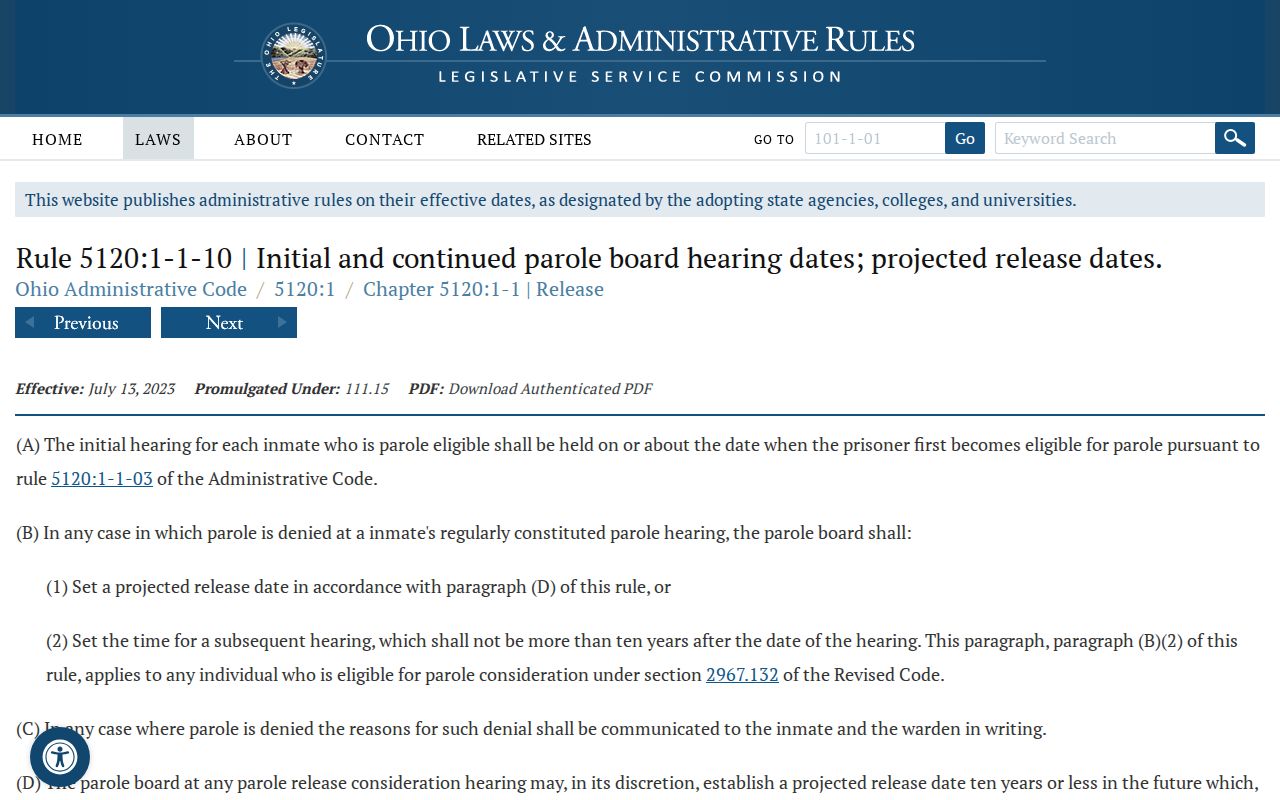
The rule supports careful verification rather than a fixed prediction from a hearing date alone.
Ashtabula County Date Records
A local release inquiry should separate calculation from proof. The sentencing entry shows the term imposed and any jail-time credit stated by the court. A commitment record identifies the authority for confinement. Bond and hold entries explain barriers to release. The jail's actual event then supplies the date, time, disposition, and possible receiving agency. Asking for those linked fields is more dependable than asking staff to estimate a future day from the sentence alone.
The same method applies after the fact. If the person vanished from local custody, check whether the event was discharge, transfer to ODRC, movement to another county, or another agency handoff. Search the receiving system before labeling the person released to the community. This distinction matters in Ashtabula because county records document out-of-county inmate placement with Geauga. Follow both agency records until the custody path is clear.